Powered by Blogger.

Blog Archive

Showing posts with label Volkswagen. Show all posts

Tuesday, April 16, 2013

Flying car concept from Volkswagen

No matter how much we advance in technology, lengthening lifespans, creating artificial organs, and plastering touchscreens of all sizes on absolutely everything, it won’t feel quite like the “future” until we can fly to work. That most basic element in depictions of the future, the flying car, has been absent from reality, somehow leaving us unconvinced of how far we’ve come.From Volkswagen, and a young gaming design student from Chengdu city, we get a flying car concept that fits not only our own desires for futurism, but also the closest idea yet to something that will effectively introduce flight into our daily routines.


Volkswagen-Hover-Car-floating-1024x640


The car basically has a spherical shape with space for two people inside. It has no wheel and floats a few inches above the ground. The image of the car floating in the middle of the street, when other autos are running on the road, is absolutely amazing. Circular glass discs have been fitted on the two ends of the car and an elongated glass panel has been fixed at the front. The glass and metal bubble looks utterly stupendous.The Volkswagen Hover Car is a pod-like zero-emissions vehicle that uses electromagnetic road networks to float above the road. The small Volkswagen has two seats and a joystick and, to demonstrate how the car would work, a Chinese couple appears to put the flying car to the test around the bustling streets of Chengdu. The two seem reluctant to climb aboard at first, but once they lift-off, they seem to enjoy all the attention the pod car gets.


Volkwsagen-Hover-Car-concept-rear-three-quarter-view-1024x640


Volkswagen-Hover-Car-in-intersection-1024x640


Flying car concept from Volkswagen

Saturday, March 9, 2013

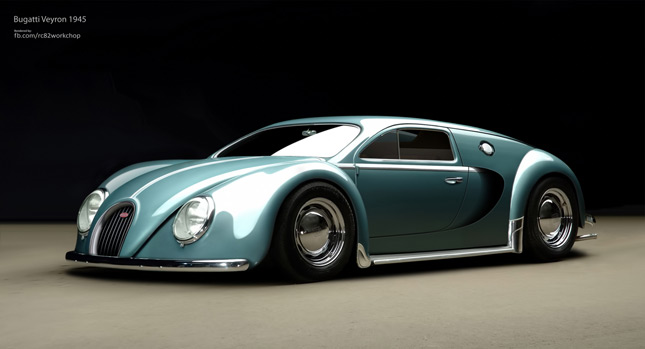
THE BUGATTI VEYRON…BEETLE EDITION

If you had any doubts that Bugatti belongs to the same group as the makers of the legendary Beetle, just take a look at this, admittedly humorous, but at the same time, high-quality digital rendering, from the creative minds at RC82 Workchop.


The Polish artist(s) incorporated all the design cues of the original (or classic) Volkswagen Beetle, from the deep-dish steel wheels and bug eyes, to the window frames and exterior door hinges, on the shape of the Bugatti Veyron hypercar.


Do you think it would be worth someone’s time, work and money to actually build a real-life version of the Bugeyron or whatever else you want to call it?


via: carscoops.com


THE BUGATTI VEYRON…BEETLE EDITION

Thursday, February 28, 2013

In the Caribbean off the coast of Cancun, Mexico, lies what looks like a old-fashioned Volkswagen Beetle. Resting in about 30 feet of water, the Bug appears to have been dropped there intact; it’s coated in algae and coral, with a few lobsters using it as habitat, but realistic enough that you can almost see the letters on its tires. It’s not a real Beetle, but part of an unusual art project that’s already become a popular destination for underwater tourists.

The Beetle was created by artist Jason DeCaires Taylor, who has filled what’s now known as the Cancun Underwater Museum with some 500 sculptures drawn from everyday life in Mexico. Taylor has been building underwater sculptures since 2006, using marine concrete — far more resistant to corrosion from sea salt than regular concrete — as a way to draw attention to the plight of natural coral reefs while taking some of the pressure from diving tourism away from them. The sculptures are also designed to resist severe hurricanes, another threat to coral reefs.

Most of Taylor’s sculptures are made from casts using live models from the local population; after carving the concrete and planting some coral colonies to spur growth, they’re lowered precisely into place by a boat-mounted crane. The original Bug remains a mainstay of life in Mexico, where it stayed in production until 2003, and only in the past few years was the last one serving as a Mexico City taxicab retired from service.

But Taylor’s life-size replica of a Bug, which he called “Anthropocene,” weighed eight tons. As this Discovery clip shows, Taylor and his team had to tie the Bug to giant air bags, then tow it six miles from shore to the drop site. They eventually put the sculpture in place — but not before dropping it a couple of times when the air bags broke free from the Bug. While the coral will make it unrecognizable in a few years, it will still keep the iconic Beetle shape well after the surface copies have turned to rust.

Photos: B.campbell65 via Flickr Via:Autos.yahoo.com


How a life-size VW Beetle becomes an underwater tourist attraction

Monday, February 25, 2013

Eleven years ago, the head of Volkswagen popped out of a capsule-shaped vehicle barely able to hold two people and announced his ambition to construct the most efficient car the world has ever seen. Today, VW revealed the production version of that car known as the XL1, which it vows will travel 261 mpg on a gallon of diesel fuel. It’s an amazing engineering feat, a Beetle reborn for the 22nd century — but the world may not be ready for it.


Saving energy in an automobile usually requires running a smaller engine, cutting weight and reducing aerodynamic drag to a minimum, and in the XL1, VW pushes all three steps to their modern limits. Power comes from a two-cylinder, 0.8-liter diesel — essentially half of VW’s standard 1.6-liter four-cylinder diesel plant — mounted in the rear of the XL1, linked to a 7-speed transmission, a 5.5 kWh lithium-ion battery and electric motor. The two-seat body of the XL1 has a 0.189 coefficient of drag (a Toyota Prius has a 0.25 Cd) and it weighs just 1,752 lbs., about half of a typical American midsize sedan.

That combination allows the XL1 to travel 31 miles on electricity alone, and over 310 miles on a tank of fuel, for what VW claims is a mileage rating of 261 mpg (or 313 mpg by European standards) — better than any other gas, diesel or electric-powered vehicle. That’s twice as efficient as the most miserly car for sale in the United States, the Scion iQ electric — which can only travel 38 miles on a full charge.

To build the XL1, Volkswagen also had to use engineering extremes usually not found outside a racetrack. The body of the XL1 will be made from carbon fiber, although using a process VW claims will be far cheaper than those applied by supercar builders such as Ferrari and Lamborghini. The XL1 will be assembled by hand in a special section of VW’s Osnabrueck factory in Germany. And to ensure the safety of the passengers in case the XL1 rolls over, the scissor doors can be blasted open with explosive bolts.

But that efficiency comes with a few sacrifices, with speed first among them. Together, the electric motor and engine produce 68 hp and 103 lb-ft of torque. VW says that’s enough to launch the XL1 to 62 mph in 12.7 seconds — although it suggests not doing so. Top speed is limited to 99 mph. And the two seat interior of the XL1 has to look stylish, because there’s nothing behind the seats; the XL1 will offer a limited amount of space under the hood. To save weight further, only a cutout of the windows roll down, like the old Subaru SVX.

Given the combination of exotic materials, engineering costs and low-speed, hand-built production, there’s no way the XL1 will make a profit for VW. It exists only due to the will of VW Chairman Ferdinand Piech — grandson of Ferdinand Porsche, the designer of the original Beetle — who has pushed VW to refine the idea of the XL1 for more than a decade. For all that VW revealed today, it didn’t announce prices, and that’s the one bit of data that will determine whether the XL1 makes sense as anything other than a corporate science project.

Via: Autos.yahoo.com


Volkswagen reveals the XL1, a 261-mpg Beetle for the 22nd century